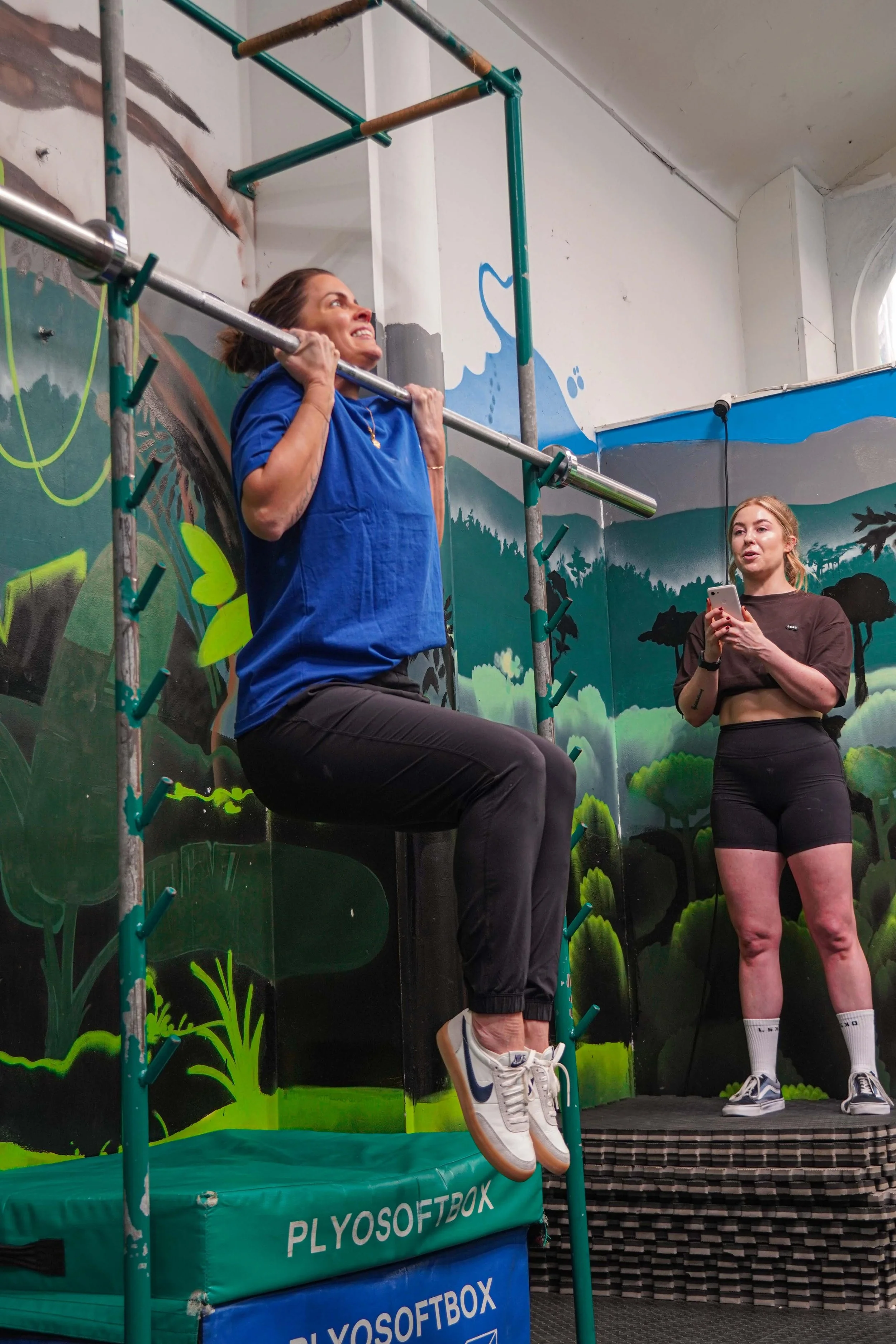
Any woman can do a pull-up. A first pull-up for a woman typically takes 6–12 weeks of targeted progression work, starting with dead hangs and building through scapular pulls, negatives, and band-assisted reps. I've coached hundreds of women through this exact process, and the ones who succeed aren't the ones who start strongest — they're the ones who follow the progression and show up consistently. This guide gives you the complete pull-up progression for women, week by week, so you can go from zero to chin over bar.
The Myth That Women Can't Do Pull-Ups
Let's kill this one fast. The idea that women "aren't built" for pull-ups is nonsense. It came from a poorly designed 2012 study that trained women for three months using the wrong methods, then declared it too hard. That study didn't use progressive overload. It didn't use negatives. It didn't use any of the tools that actually work.
Here's the truth: women's strength training has been held back by low expectations, not by biology. Yes, women tend to have less upper-body muscle mass as a starting point. That just means the progression takes a little longer — not that the destination is different. Calisthenics for women works the same way it works for everyone: apply the right stimulus, recover, adapt, repeat.
I've watched women who couldn't hang for five seconds eventually bang out sets of five strict pull-ups. Every single time, the method was the same. And that's what I'm giving you here.
The Pull-Up Progression for Women
This is the exact progression I use with my online coaching clients. Each phase builds on the last. Don't skip steps — the connective tissue in your elbows, shoulders, and wrists needs time to catch up with your muscles.
Phase 1: Dead Hang (Weeks 1–2)
Before you pull, you grip. A dead hang is exactly what it sounds like: grab the bar with an overhand grip, lift your feet, and hang. That's it. Your goal is to build grip endurance and get your shoulders used to bearing load.
- Target: 3 sets of 20–30 second hangs, 3x per week
- Use a bar you can reach without jumping — step off a box
- Keep shoulders packed slightly (not shrugged to your ears)
- If 10 seconds is your max, start there — progress 5 seconds per week
Phase 2: Scapular Pulls (Weeks 2–3)
From a dead hang, you're going to pull your shoulder blades down and together without bending your elbows. Your body rises maybe 5 centimetres. It looks like nothing. It's everything.
Scapular pulls teach your lats to fire. Most women starting out don't have a strong mind-muscle connection with their back — this fixes that. Aim for 3 sets of 8–10 reps. Hold the top position for 2 seconds.
Phase 3: Negatives (Weeks 3–5)
This is where the real strength gets built. Jump or step up so your chin is over the bar, then lower yourself as slowly as possible. A good negative takes 5–8 seconds. A great one takes 10.
- Target: 3–4 sets of 3–5 negatives, 3x per week
- Focus on control, not volume — a fast negative is a wasted rep
- If you drop like a stone after 2 seconds, that's your starting point
- Add 1–2 seconds per week to your lowering time
The negative phase is where I see the biggest breakthroughs. You are stronger in the eccentric (lowering) portion of a movement than the concentric (pulling). Use that to your advantage.
Phase 4: Band-Assisted Pull-Ups (Weeks 4–6)
Loop a resistance band over the bar and place your foot or knee in it. The band reduces the load at the bottom of the rep (where you're weakest) and gives less help at the top. Start with a heavy band and progress to lighter ones over time.
- Use full range of motion — dead hang to chin over bar
- Target: 3–4 sets of 5–8 reps
- Don't get stuck on bands forever — they're a tool, not a destination
- Combine with negatives in the same session for maximum stimulus
Phase 5: Eccentric Focus + Half Reps (Weeks 6–7)
Now you're combining everything. Perform a band-assisted pull-up on the way up, then remove the band support and do a slow negative on the way down. You're also going to start attempting half pull-ups — pulling from a dead hang to the halfway point using your own strength.
This phase is brutal and beautiful. Your nervous system is learning to recruit every available muscle fibre. You'll feel it in your lats, your forearms, your core. That soreness means it's working.
Phase 6: Your First Full Pull-Up (Week 8)
Test day. Warm up thoroughly — 5 minutes of light cardio, arm circles, band pull-aparts, a few scapular pulls. Then step up to the bar. Grip it. Breathe. And pull.
If it doesn't happen on day one of week 8, that's fine. Some women get it at week 6. Others at week 10. The timeline doesn't matter as much as the direction. You're closer than you think.
The 8-Week Overview
- Weeks 1–2: Dead hangs (building grip and shoulder stability) + scapular pulls
- Weeks 3–4: Negatives (5–10 second lowering) + scapular pulls
- Weeks 4–5: Introduce band-assisted pull-ups alongside negatives
- Weeks 6–7: Eccentric-focused reps, half pull-ups, reducing band assistance
- Week 8: Test unassisted pull-up, continue building volume
Train pull-up work 3 times per week with at least one rest day between sessions. Each session should include 12–16 total working sets across your pull-up progression and supporting exercises (rows, bicep curls, core work).
Common Mistakes That Stall Your Progress
I see these constantly. If your pull-up progress has stalled, one of these is probably why.
- Kipping or swinging: Momentum robs your muscles of the stimulus they need. Every rep should be controlled and strict.
- Skipping negatives: The eccentric phase is where you build the most strength. If you're only doing band-assisted work, you're leaving gains on the table.
- Going too heavy on bands: A thick band that catapults you to the top teaches you nothing. Use the lightest band that lets you complete the rep with good form.
- Neglecting your core: A pull-up is a full-body movement. If your core is weak, your body swings and wastes energy. Add hollow holds and hanging knee raises.
- Not training frequently enough: Once a week won't cut it. Your nervous system needs repeated exposure to learn the movement pattern. Three times is the minimum.
- Ignoring bodyweight: This isn't about being lighter — it's about being stronger relative to your weight. Focus on building muscle, not losing it.
Mindset Matters More Than Strength
I know that sounds like a bumper sticker. But hear me out.
The women I've coached who get their first pull-up fastest aren't always the strongest ones on day one. They're the ones who decide it's going to happen and then refuse to negotiate with themselves about showing up. They do their negatives when they don't feel like it. They hang from the bar when it's boring. They trust the process even when progress feels invisible.
Strength is built in the weeks you don't feel like training. The pull-up happens on the day you do it anyway.
Most women have been told — explicitly or implicitly — that pull-ups aren't for them. That upper-body strength is a male domain. That women's strength training should stay in the "light weights, high reps" lane. Doing your first pull-up isn't just a physical achievement. It's a declaration that you're done accepting limits that were never yours.
Your body is capable of far more than you think. The bar doesn't know your gender. It only knows whether you've put in the work.
What Comes After Your First Pull-Up
One pull-up becomes two. Two becomes five. Five becomes weighted pull-ups, muscle-ups, and movements you didn't know your body could do. The first pull-up is the hardest one you'll ever do — and the most important. It's proof of concept. Proof that progressive overload works, that your body adapts, that you are an athlete.
If you want a coach in your corner for this — someone who programs your progression, adjusts your volume, and keeps you accountable — that's exactly what I do. I've helped women across Australia and around the world unlock their first pull-up through calisthenics for women programming that's built around your life, your schedule, and your starting point.
The bar is waiting. Go hang from it.
